climate
Where did the money go?
Nearly a third of your KSh 5,000 electricity spend goes to taxes and extra charges. So how many units does your money actually buy ?
Visual Data Insights · 2026-10-20
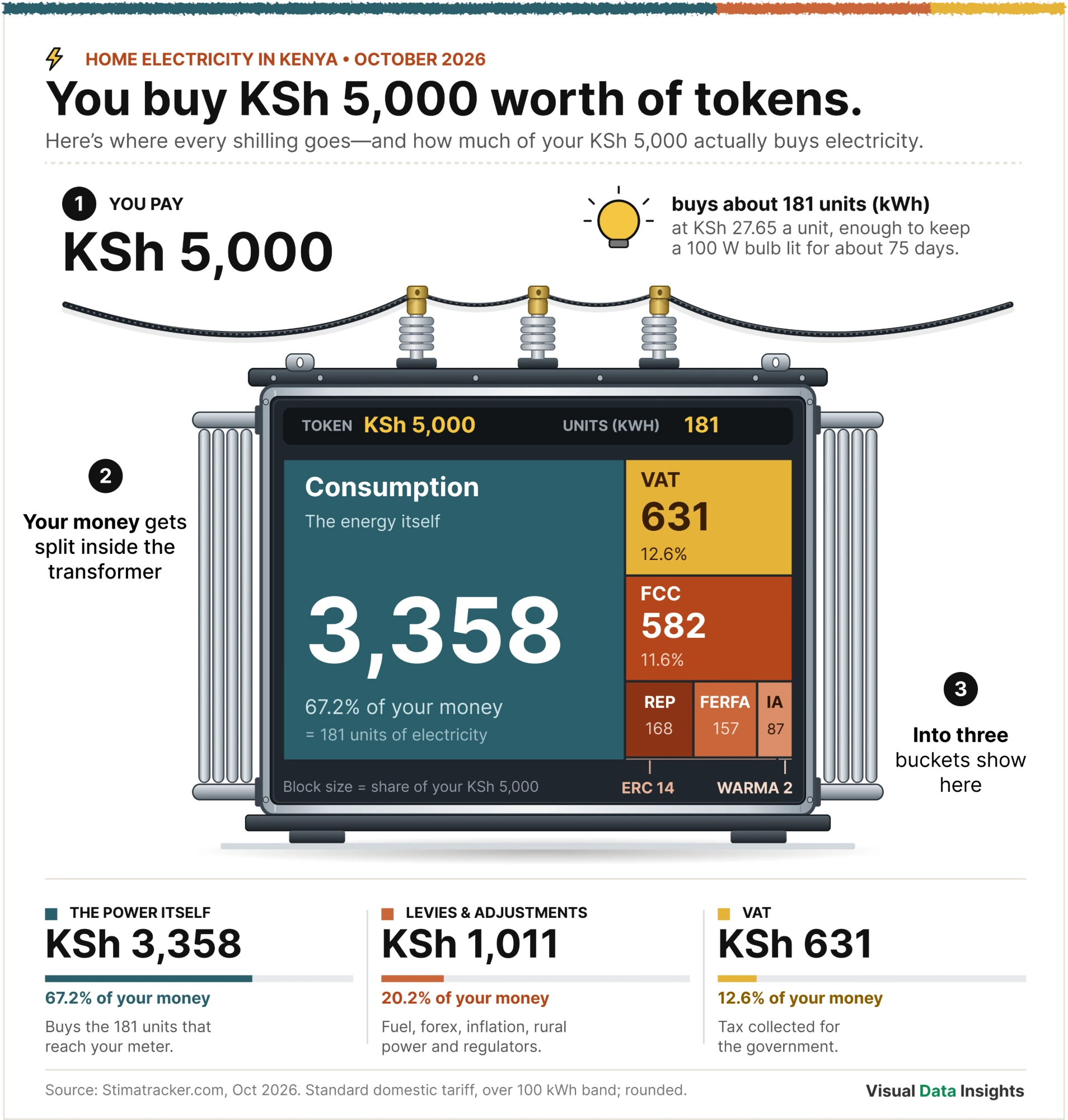
On the 1st of every month, just after payday, a mother in Nairobi buys KSh 5,000 in electricity tokens. At 8 p.m., she enters the numbers, hears the familiar beep, and returns to dinner as her children study under the lights.
But the meter tells a different story. In October 2026, KSh 5,000 buys roughly 181 units of electricity. What it doesn’t show is where the rest of the money goes. Before the lights come on, a sizeable share has already been taken up by other charges.
Let's Visualize this.......
Follow the money, and the answer begins to emerge
Of the KSh 5,000, about KSh 3,358 pays for the electricity itself. Another KSh 631 goes to VAT, KSh 582 to fuel costs and KSh 157 to foreign-exchange adjustments. Other charges account for the remainder.
Add them together: KSh 1,642. That is nearly one-third of the original purchase, absorbed by taxes, adjustments and other charges rather than the electricity component itself. The household has paid every shilling, but only about 67% of the money goes towards the electricity component.
Each deduction has its own explanation. Fuel costs reflect changes in the cost of generation; foreign-exchange adjustments account for currency movements; taxes and levies serve other purposes. These are not necessarily arbitrary charges.
But to the person entering the token, their combined effect is simpler: KSh 1,642 is gone before the countdown begins.
The hidden price
Kenya’s base tariff for households using more than 100 units a month is KSh 18.57 per unit. But that is only the starting point. Fuel costs fluctuate, currency adjustments shift, and taxes and levies add to the final bill.
There are, in effect, two prices: what electricity costs on paper and what households actually pay. And when every shilling must stretch to the next payday, the difference matters. The extra charges do not just raise the bill; they leave fewer units on the meter and less time before the lights go out.
The tariff tells you what a unit costs. The token tells you how much electricity your money can actually buy.
The countdown
Back in the Nairobi kitchen, dinner is cooking, and the children are studying. Nobody is thinking about fuel costs or currency adjustments. They are thinking about how long the tokens will last.
The meter keeps counting down: lights, cooking, phones, the fridge. Every unit matters. And the KSh 1,642 is already gone. The figures do not tell us whether every charge is justified. But they reveal the gap between what households pay and what they get.
When the low-token warning finally sounds, the meter will not explain where the money went. It will simply ask for more.
KSh 5,000 buys 181 units. The question is: how long will they last?
Source: https://www.stimatracker.com/