tech
The AI adoption curve is running out of road
Almost nine in ten companies now report using AI. The more interesting question is what that number will mean when nearly everyone says yes.
Visual Data Insights · 2026-09-21
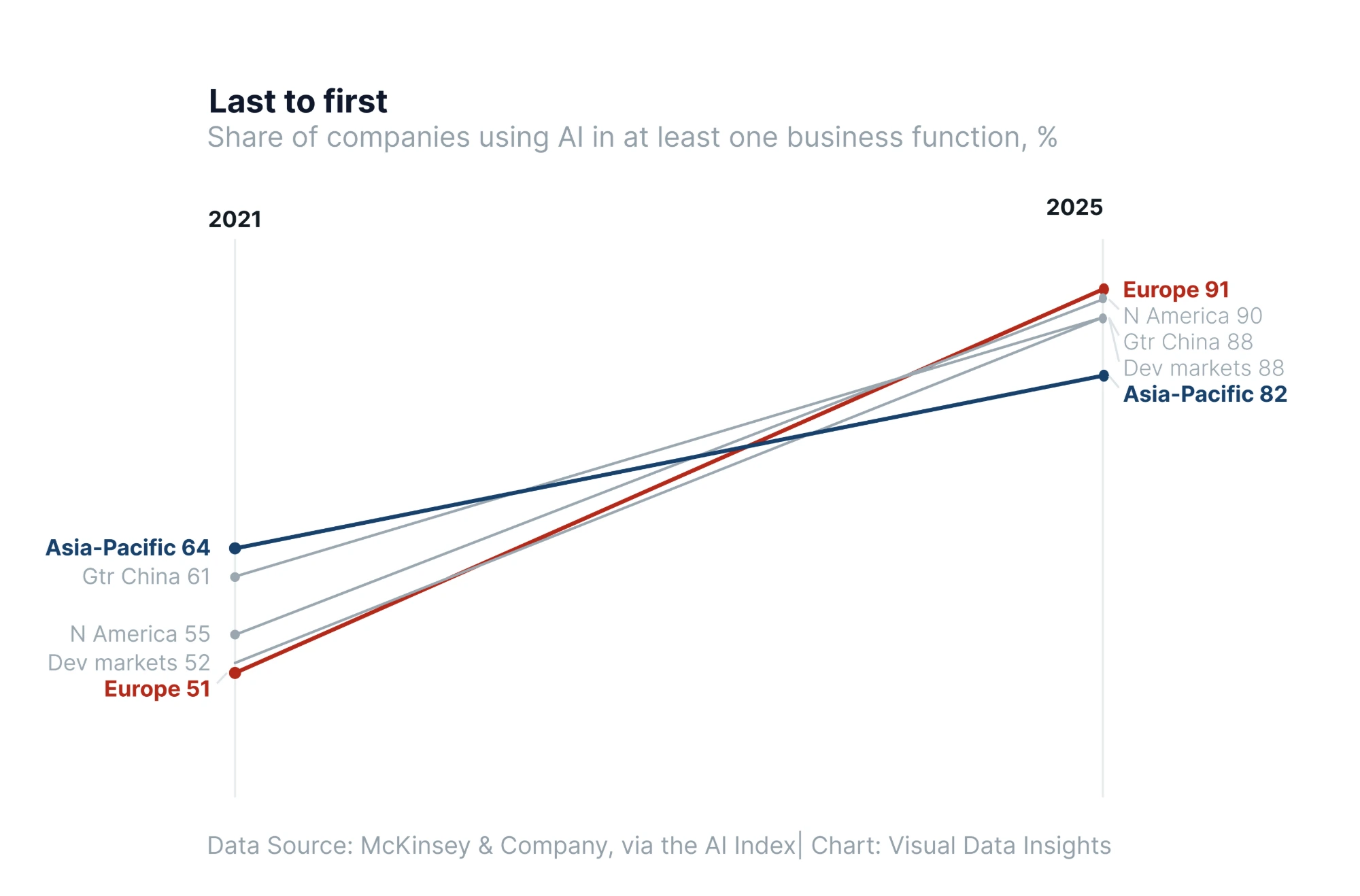
Share of companies reporting AI use, % .In 2021, 56% of companies surveyed by McKinsey said they used artificial intelligence in at least one business function. In 2025, the figure was 88%.
That sounds like a revolution. It is—but not quite the one the headline number suggests.
The definition of “use” is deliberately broad. A company can qualify because a few employees experiment with an AI tool; another might have embedded machine learning into its operations. The survey counts both.
That makes the direction more interesting than the absolute level. AI has gone from something companies were trying to something most companies now say they are doing.
The acceleration has also been uneven. Europe went from 51% adoption in 2021 to 91% in 2025. North America rose from 55% to 90%. Developing markets climbed from roughly 52% to 88%.
Asia-Pacific tells a different story. It started in front, with 64% of companies reporting AI use in 2021, but reached 82% in 2025—the smallest increase among the regions shown.
The gap between regions has therefore narrowed considerably. What looked like a technology adopted at different speeds increasingly looks like one becoming ubiquitous.
A curious interruption
AI adoption dipped in 2022 before taking off There is one wrinkle in the otherwise upward story. Reported adoption fell in 2022, from 56% to 50% globally. Greater China recorded the most striking drop, from 61% to 41%.
After the dip, adoption returned to 55% in 2023, then jumped to 78% in 2024 and 88% in 2025. The four-year trend is considerably less mysterious than the year-to-year movements. And 2024 was the inflection point: adoption rose by 23 percentage points in a single year.
Generative AI probably helped turn AI from a specialist technology into something ordinary employees could encounter directly. A chatbot was suddenly enough to give a company an AI story.
The problem with 88%
Share of companies reporting AI use in 2025, % At 91%, Europe now has only nine percentage points between its reported adoption rate and universal adoption. North America is at 90%; Greater China and developing markets are both at 88%. Asia-Pacific, despite remaining the lowest of the five regions in 2025, is still at 82%. That creates a measurement problem.
Once four out of five companies—or nine out of ten—say they use AI, the question stops telling us very much about the differences between them. A small business using ChatGPT to draft emails and a multinational redesigning its supply chain with machine learning can both answer “yes”.
The next phase of the AI story is therefore less about whether companies use it and more about how much they use it.
How many functions use it? How many employees? How much spending, revenue or productivity depends on it? Adoption made AI normal. Now the real question is what companies actually do with it.