politics
Cognitive Biases Shaping Kenyan Politics
Mental shortcuts quietly decide what Kenyans believe about their leaders — and not one of them needs a politician to say a false word.
Visual Data Insights · 2026-09-06
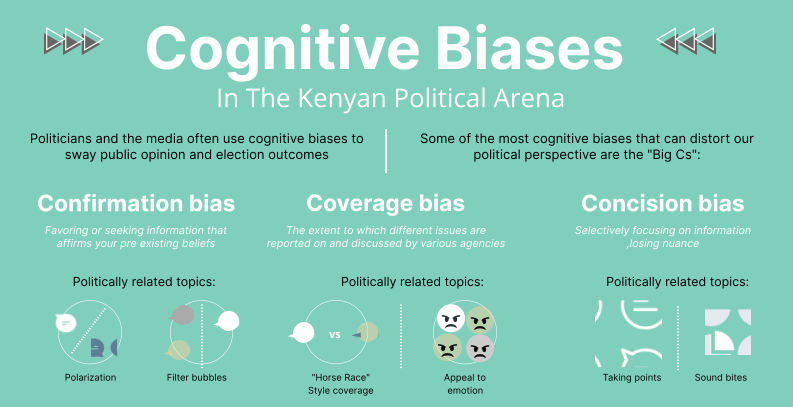
Strip away the rallies, caps, and slogans. Kenyan politics runs on something smaller: the glitches in how our brains sort truth from noise. Campaigns don't always need to persuade us — sometimes they just need to trigger us.
Three filters, one funnel
Confirmation bias lets two Kenyans watch the same debate and walk away certain of opposite things, each only ever hearing what they already believed — the incumbent's supporter hears "economic recovery," the opposition's supporter hears "empty promises," from the very same sentence.
Coverage bias decides what gets airtime — scandal outruns substance because newsrooms chase the chase, not the receipt.
Concision bias flattens a two-hundred-page bill into six words, "reject," that fit a placard — and those six words, however hollow, are what a voter actually remembers.
The filters don't care what's true. They care what's sticky. Once a claim gets through, it stops being information — it becomes raw material for manufacturing confidence.
Manufacturing certainty
Authority bias rewards volume over rigour — a boardroom remark on looming taxes outruns the analyst who flagged the same risk days earlier and was ignored. Feed that remark into an availability cascade, and repetition quietly replaces evidence: enough people repeating a claim makes checking it feel unnecessary. Where fact-checking is thin, the cascade doesn't just travel — it calcifies.
The same trick works on people, not just claims. The Dunning-Kruger effect hands the microphone to whoever understands a subject least, since thin knowledge breeds thick confidence — and a confident voice has already done the work a checked one was supposed to do. The halo effect finishes the job: warmth gets silently upgraded into competence, so "likeable" does the work "capable" was meant to do. A claim just faked its way to credible. A candidate just faked their way to competent.
None of this would matter if a bad impression could be corrected later. It rarely gets the chance.
The Habits.
Declinism turns any contested policy into fresh proof the country is collapsing, verdict reached before the data's even opened. The framing effect shows how little a fact must change to flip a verdict — "borrowing again" and "record debt amid corruption" describe the same loan. Groupthink punishes dissent, keeping voters loyal to candidates they privately doubt. False consensus closes the loop, letting everyone assume the country agrees with them because their own circle already does.
None of the four needs a villain — which is exactly why none of them die.
Trace it back far enough, and you find the truth: no one had to lie. The filters, manufactured confidence, and habits did the work politicians never had to.