cities
Burundi’s Migration: From Where to Where
383,000 people living in Burundi were born elsewhere, while 580,000 people born in Burundi live abroad — a gap of nearly 200,000.
Visual Data Insights · 2026-09-08
Burundi is one of Africa's smallest and most densely populated countries, wedged between the Democratic Republic of Congo, Rwanda and Tanzania — three of the very countries that dominate its migration statistics. In 2024, an estimated 383,000 people living within its borders were born elsewhere, while more than half a million people born in Burundi were living abroad. Set against a population of roughly 13 million, both figures are substantial: together they describe a country shaped as much by who arrives and who leaves as by who stays.
The flows.
Every migration story has two sides — an inflow and an outflow — and they rarely mirror each other. Burundi's immigrant population and its diaspora are drawn from an overlapping set of neighbours, but in very different proportions. Untangling the two requires looking at them separately before putting them back together.
The immigrant population tells one story. The diaspora tells another — and the two don't agree.
Where immigrants come from.
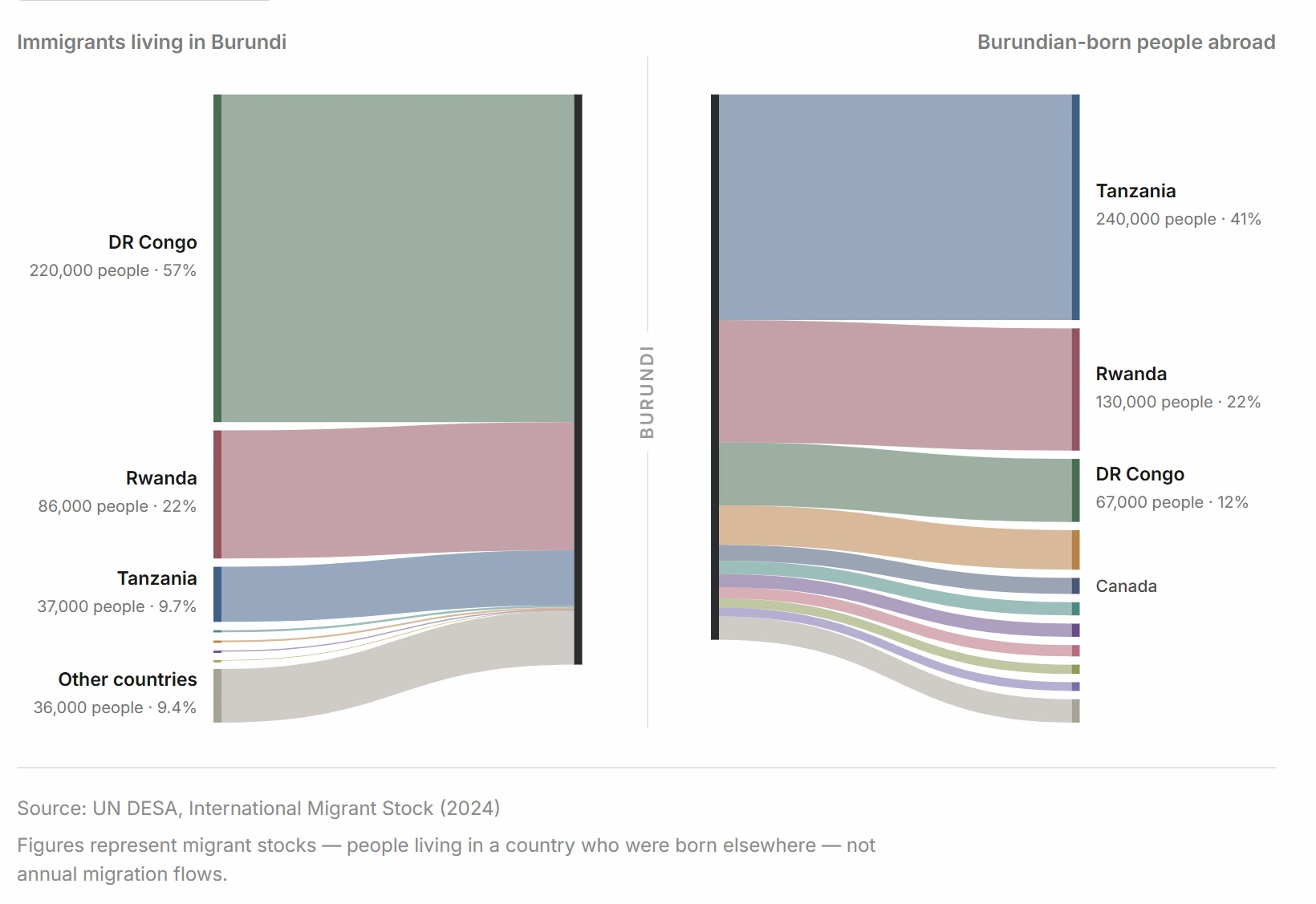
Of Burundi’s 383,000 immigrants in 2024, 220,000 (57%) were born in the DR Congo — more than all other origins combined. Rwanda follows with 86,000 (22%), and Tanzania with 37,000 (9.7%). The remaining 36,000 (9.4%) came from other countries.
The DR Congo’s dominance reflects decades of conflict and displacement across Burundi’s long, contested border.
Burundians abroad.
The picture abroad is similarly concentrated. Of the 580,000 people born in Burundi living abroad, 240,000 (41%) are in Tanzania, the largest destination. Rwanda hosts 130,000 (22%), the Democratic Republic of Congo 67,000 (12%), and Uganda 42,000 (7.2%). Beyond these four, the diaspora thins quickly, with Canada, Kenya, Belgium, South Africa, Malawi and Zambia hosting smaller numbers, while 24,900 fall into the “other” category.
Tanzania and Rwanda’s dual role — hosting large Burundian communities while also sending migrants into Burundi — points to a regional migration system rather than a one-way flow. Burundi’s civil war in the 1990s and political crisis in 2015 sent successive waves of refugees into neighbouring countries, a history still visible in today’s migrant stock.
Put the two totals side by side, and a clearer pattern emerges.
Reading the balance
Burundi looks like a net exporter of people: 580,000 Burundian-born residents live abroad, compared with 383,000 immigrants living in Burundi — a gap of roughly 197,000.
But migrant stock reflects who lives where at a point in time, not the pace or direction of migration in a given year. Today’s diaspora can therefore reflect refugee movements from decades ago as much as recent migration.
The broader picture is clear: Burundi is tightly connected to its regional neighbours. DR Congo, Rwanda and Tanzania appear on both sides of its migration ledger and account for most of both its immigrants and diaspora.