tech
Anthropic Overtakes OpenAI in Business AI Spending
Anthropic has overtaken OpenAI among U.S. businesses paying for AI, ending three years of single-vendor dominance. And almost none of that growth came at OpenAI’s expense.
Visual Data Insights · 2026-09-18
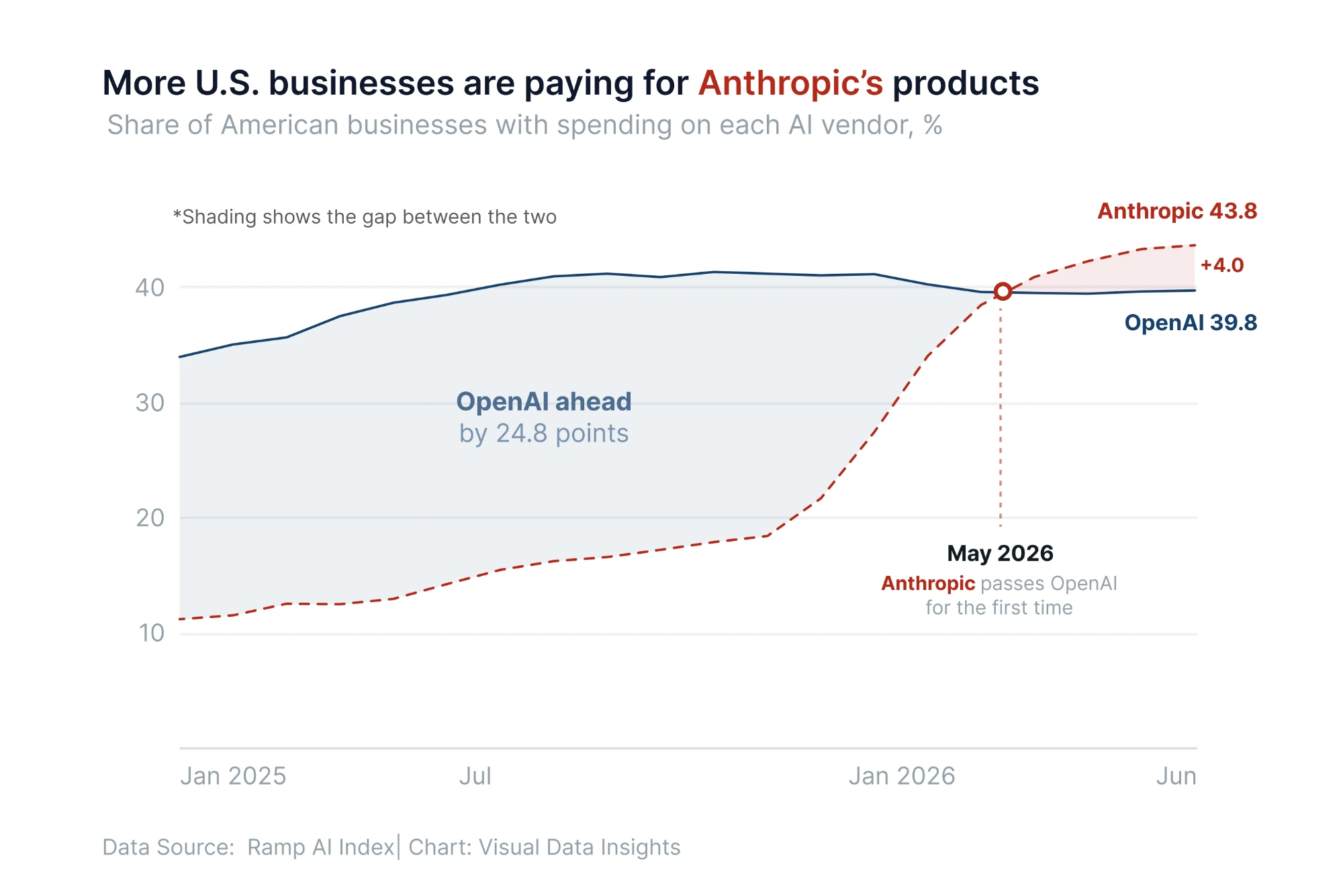
For three years, one name dominated the software column on company credit card statements: OpenAI. Then, sometime in 2026, a second name started appearing — and it wasn't just another AI experiment. In May 2026, Anthropic overtook OpenAI in the share of American businesses spending on AI models, subscriptions, tokens, and APIs.
Ramp’s AI Index tracks the share of businesses paying each AI vendor across American businesses. It doesn't measure revenue or usage, but it offers a rare glimpse into what companies are actually buying. For years, the pattern barely changed. OpenAI surged in 2023, reaching roughly 40% of businesses in 2025, then flattened.
Anthropic crept up
Until 2026. It gained 25.6 percentage points in its fastest eight months, narrowly exceeding OpenAI's 24.7-point surge after ChatGPT's launch.
But the curves tell different stories.
OpenAI exploded out of the gate and slowed. Anthropic accelerated for months before reaching its peak.
By in May 2026, it had passed OpenAI.
And here's the strange part: OpenAI's customers didn't appear to leave. Its share fell only 1.6 points from its November 2025 peak before recovering. There simply aren't enough lost customers to explain Anthropic's rise. Companies seem to be adding AI vendors, not replacing them.
The rest of the market is nowhere close. Google has spent three years stuck between roughly 4.6% and 6.4%. xAI remains below 5%. DeepSeek's much-hyped arrival barely registers in business spending. Mistral is almost flat.
So the corporate AI bill now has a curious shape: two vendors on roughly two-fifths of business invoices each. The other four barely reach a ninth combined. The next battle may not be about replacing OpenAI. It may be about getting finance to approve one more AI charge. And so far, very few companies have managed it.