economy
Africa's Most Remittance-Dependent Economies (2024) 💸
Money sent home by migrants rarely makes front-page economic headlines. Yet for millions of families across Africa, these quiet transfers—often sent in modest.
Timothy Pesi · 2026-09-01
Money sent home by migrants rarely makes front-page economic headlines. Yet for millions of families across Africa, these quiet transfers—often sent in modest monthly installments—are the difference between subsistence and stability.
In many African economies, these flows are not merely helpful—they are macroeconomically essential. And when we map them, the story becomes striking.
A continent powered by its diaspora
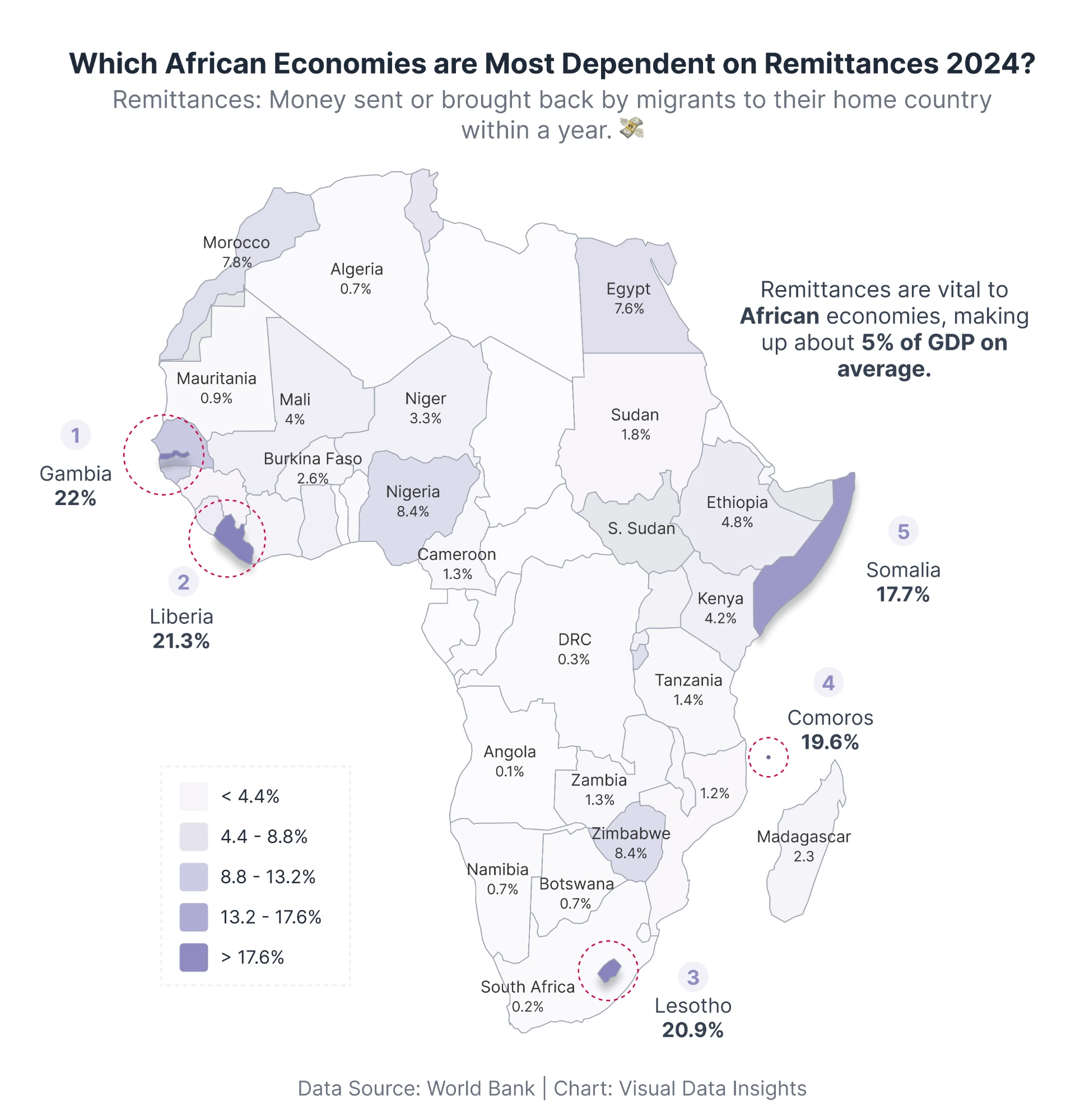
Remittances across Africa average around 5% of GDP, but that average hides a dramatic reality: in several countries, money sent home from abroad forms a double-digit share of the national economy.
In these economies, remittances act as a parallel financial system, sustaining households and stabilizing foreign exchange reserves. The chart below tells the story visually.
The geography of dependence
A glance at the map reveals three interesting regional patterns.
West Africa dominates the top rankings. Countries like Gambia and Liberia rely heavily on diaspora income, reflecting large migrant communities in Europe and the United States.
Small economies are the most reliant. Tiny nations such as Lesotho and Comoros often lack diversified industries, making remittances a crucial economic engine.
Fragile states depend heavily on diaspora support. In Somalia, remittances function almost like a substitute for formal economic institutions, helping families pay for food, healthcare, and education. Even larger economies benefit significantly. Nigeria, Africa's biggest economy, receives enormous remittance volumes, though they represent a smaller share of GDP (about 8.4%).
The household safety net
At the micro level, remittances perform a function few other financial flows can replicate: they reach households directly.
Unlike foreign aid or government programs, remittances typically arrive with no bureaucracy attached. Families use them to:
Pay school fees
Buy food and essentials
Build homes
Start small businesses
During economic shocks—whether inflation, drought, or political instability—remittances often rise rather than fall, acting as an informal insurance system.
In short, migrants become their families' central banks.
Sending money isn't cheap
Yet there is a catch. Despite their importance, remittances remain expensive to send, especially to Africa. Fees can climb as high as 10% of the amount transferred on some corridors. That means when a migrant sends $200 home, their family may only receive $180—or less. For economies where remittances account for one-fifth of GDP, these costs represent a silent but significant tax on development.
Globalization, one transfer at a time
Remittances rarely arrive with ceremony. There are no ribbon cuttings, no ministerial speeches, no grand infrastructure projects to photograph. Instead, they arrive quietly—through bank transfers, mobile wallets, and remittance apps. But collectively, these flows amount to tens of billions of dollars entering African economies every year.
In an era where global capital can move at the speed of light, the most impactful financial transfers may still be the simplest: a worker abroad sending part of their paycheck home. For many African economies, the diaspora is not just a community abroad.
It is an economic lifeline.