development
Priced Out
The world's poorest countries spend $116 a year keeping each person alive. That is not a smaller version of what rich countries do — it is a different order of problem entirely.
Visual Data Insights · 2026-09-01
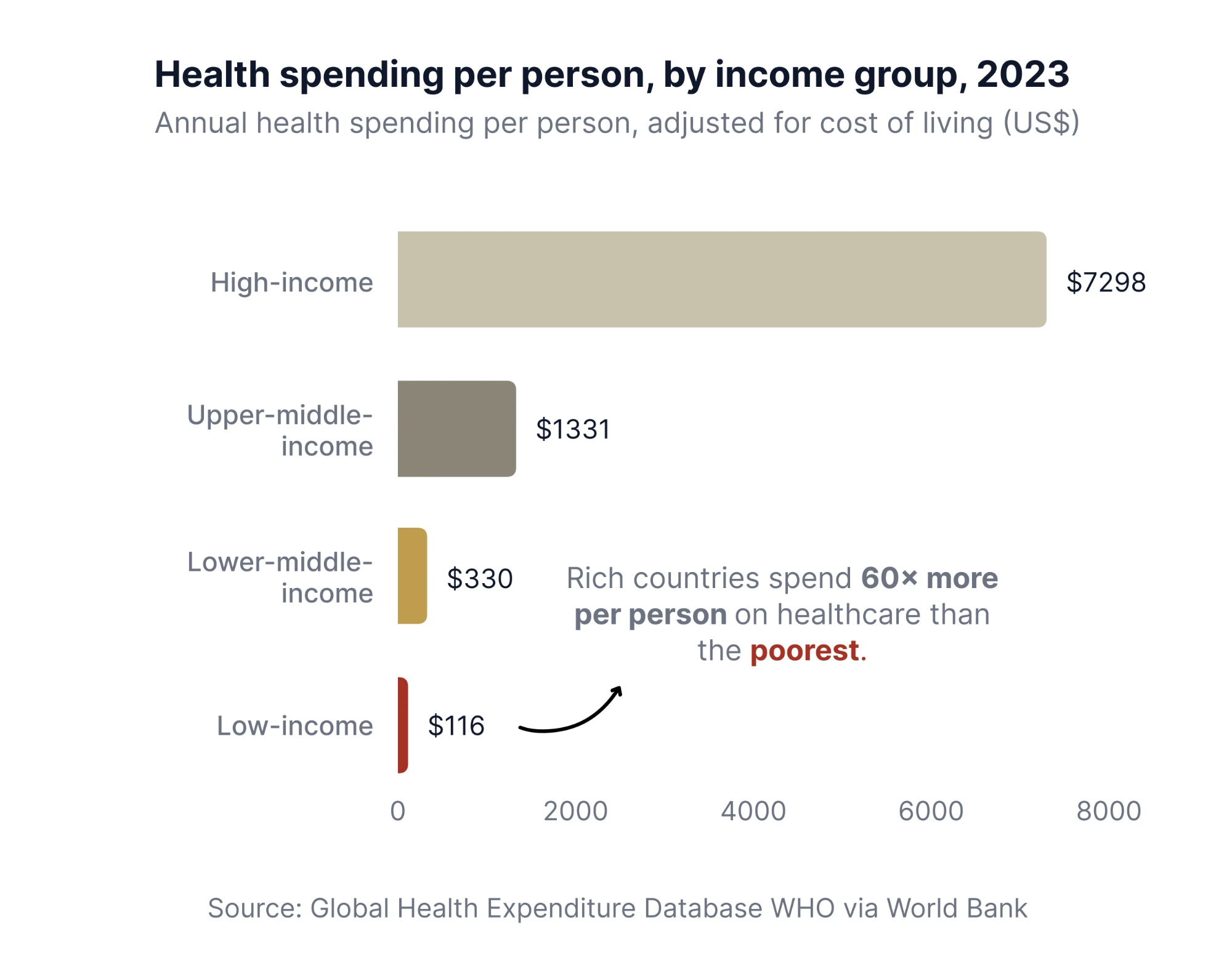
In a low-income country, $116 is not a health budget in the way richer countries would recognise one. It is the entire year's allowance, per person, for every doctor's visit, every course of antibiotics, every childhood vaccination and every complicated birth — all of it drawn from the same thin pool. In a high-income country, the equivalent figure is $7,298. The rich-world number isn't a bit bigger. It is 63 times bigger.
The bar for low-income countries is so short it barely clears the axis. Zoom out to how the money is actually divided up, and the poorest tier all but disappears.
A Budget That Has to Do Everything
At $116 a person, a health system has no real room to separate prevention from treatment, or routine care from emergencies — the same limited pool has to stretch across all of it at once. Lower-middle-income countries fare a little better, at $330 per person, nearly three times as much. But that figure is still a fraction of the $1,331 that upper-middle-income countries manage, and barely a rounding error beside the high-income figure. Put the four groups' per-person totals into a single pool, and the picture sharpens further: high-income countries alone account for more than four-fifths of it. Low-income countries hold a little over one percent.
Between them, the two poorest income tiers command less than one-twentieth of the combined total — and low-income countries, on their own, barely register at all.
What a Thin Budget Buys
Money is not the whole story in health. But it is hard to find an outcome that doesn't track this same ladder.
Life expectancy in low-income countries runs roughly sixteen years behind high-income ones. Child mortality and maternal mortality both worsen sharply at each step down the income scale, and so does the overall burden of disease. None of that is coincidence: a per-person budget of $116 dictates how many doctors a country can train, how many hospital beds it can build, how many vaccine doses it can stock, and how much shock — a bad disease season, a drought, a new pathogen — a health system can absorb before it starts to fail people.
The real story here isn't that rich countries spend a great deal on health. It's that the poorest countries have almost nothing to spend, and that ceiling — not a lack of medical knowledge — is what sets the limit on what's achievable for hundreds of millions of people. Closing even a slice of a 63-fold gap would do more for global health than most single medical breakthroughs on the horizon.