cities
Africa’s Passport Divide: Where Can You Travel Without a Vis
Seychellois and Mauritian travelers can enter about 150 destinations without a visa in hand. A Somali passport opens 32. The latest global ranking shows how uneven African mobility remains, and that it slipped again this year.
Visual Data Insights · 2026-10-30
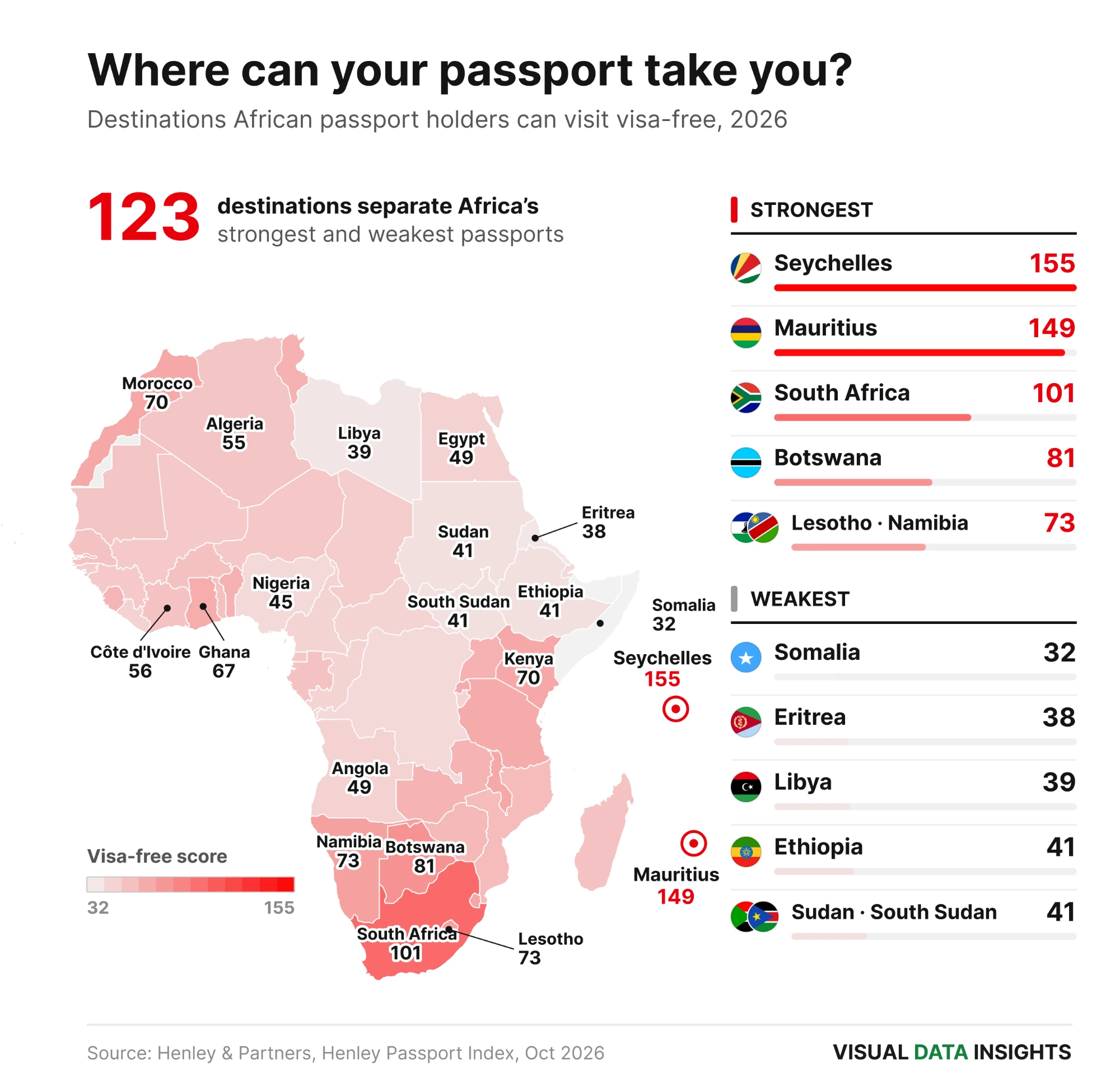
From Victoria, Seychelles, a passport opens the door to 155 destinations without a visa in advance. From Mogadishu, Somalia, just 1,350 kilometres away, it opens only 32. That is a gap of 123 destinations — two African passports, two very different worlds.
The contrast anchors the October edition of the Henley Passport Index, compiled by Henley & Partners using International Air Transport Association data. It measures how many of 227 destinations passport holders can access without securing a visa beforehand.
Across Africa’s 54 passports, the average is just 61 destinations. Only three reach 100, while 33 fall below the continental average. The median passport opens 56 destinations — roughly the same reach as India’s.
Africa in the world
Half the world’s weakest passports, three of its strongest hundred. Set against the full global table, the pattern is stark. Of the 100 weakest passports in the index, 51 are African. Of the 100 strongest, just three are: Seychelles, Mauritius and South Africa.
A Seychellois passport opens nearly five times as many doors as a Somali one. That is close to the gap between a Seychellois passport and Singapore’s, the world’s strongest, which opens 193.
The top five
Islands lead, then the south. The two strongest passports in Africa belong to small island states. Seychelles, with 155, shares 23rd place worldwide with Mexico and Uruguay. Mauritius follows at 149, 26th in the world. Both outrank the passports of Russia (114) and Türkiye (112).
South Africa is the only mainland country to break 100, with a score of 101. Botswana comes next at 81, nearly level with China’s 83. Lesotho and Namibia share fifth place at 73.
The fall-off is steep. From Mauritius to South Africa, the score drops by 48. After Botswana, the remaining 49 African passports are packed into a narrow band between 32 and 73.
The bottom five
At the bottom, weak passports trace a map of instability. Somalia offers access to just 32 destinations, followed by Eritrea (38), Libya (39), and Ethiopia, Sudan and South Sudan (41).
The numbers reflect years of conflict, political isolation and instability. But Ethiopia is the striking contradiction: home to one of Africa’s largest airlines and its second most populous country, yet its passport has lost five destinations since 2024.
A regional divide
Southern Africa leads with an average of 80 destinations, while Central Africa trails at 51. East Africa averages 66, but Seychelles and Mauritius lift the score; without them, it falls to 55.
West Africa’s 16 passports are tightly clustered between 45 and 69, while North Africa is sharply divided: Morocco and Tunisia score 70 and 65, against Libya’s 39 and Sudan’s 41.
The pattern is clear: where you live in Africa still makes a striking difference to how far your passport can take you.
Slipping, almost everywhere
The decline is widespread. Of the 22 African passports tracked since 2024, 20 lost destinations, two stagnated, and none improved. The average loss was nearly three destinations. Botswana fell the furthest (−7), followed by Zambia (−6). South Africa, Ethiopia and Malawi each lost five.
What it adds up to
Even Africa’s strongest passport trails Singapore’s by 38 destinations. The typical African passport offers mobility closer to India or Indonesia than to most of Europe or East Asia.
Size offers no advantage: Nigeria and Ethiopia, Africa’s most populous countries, rank among its weakest. Nor does geography guarantee access: Seychelles and Somalia are neighbours, yet their passports differ by 123 destinations.
For most Africans, the world became harder to reach between 2024 and 2026.