economy
Ride-Hailing Industry Survey in Kenya
A minimum fare is supposed to be a rare policy win — better pay for drivers, no losers. Nairobi's commuters don't see it that way.
Visual Data Insights · 2026-09-04
Nairobi's ride-hailing drivers have a strong case: over half depend on the app as their main income, and the government wants to guarantee them a fairer per-trip floor. Yet when TIFA Research read out the actual proposal to 733 residents in July, three in five rejected it outright.
Before getting into why, it's worth being clear on what's actually on the table.
The Proposal, In Plain Terms
Right now, ride-hailing fares in Kenya move with supply and demand — Bolt, Uber, Little Cab and Faras set their own prices, and a short trip can cost as little as KES 180 to 220. The government wants to replace that floor with a government-mandated minimum fare: a higher price below which no ride can legally be booked, meant to guarantee drivers a steadier, fairer income regardless of how platforms compete.
According to KNBS Consumer Price Indices, rising prices across everyday goods have already eaten into consumers' disposable income — leaving little room to absorb yet another rising cost. That's the budget any change to ride-hailing fares would land on.
Nothing Left to Give
Tomatoes cost 41% more than a year ago, diesel 30% more, kale 27% more. Four in five Nairobi households say they're already dealing with either rising costs or a shrinking income, and 92% call themselves at least somewhat worried about everyday prices. A commuter reading that chart isn't thinking about driver welfare — they're thinking about their own fare home.
That single fact does more to explain the survey's results than the policy itself does.
The market already has their trust. 63% want Bolt, Uber, Little Cab and Faras to keep competing on price rather than have the government set it — a preference that holds steady across age, income and gender.
The proposal never reached most people. 73% of riders had heard nothing about it before this survey brought it up.
Those who had heard of it read it as a cost, not a fix. 57% expect their own fares to rise; only 18% expect fairer pricing or better pay for drivers.
Add it up, and the real question isn't whether people support the idea in principle — it's what they'd actually do if it landed on their next ride. That's the number this whole debate turns on.
If It Goes Through
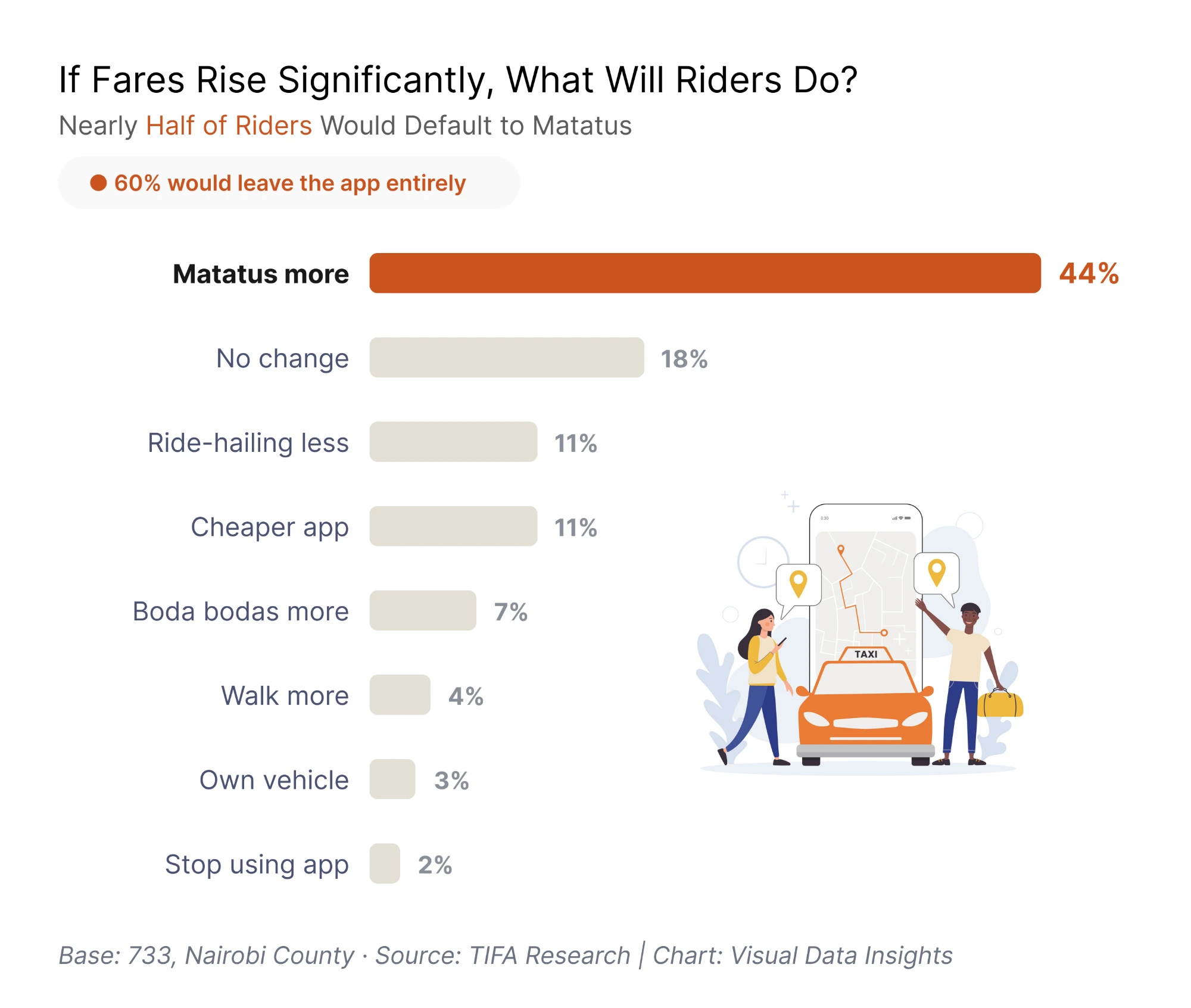
TIFA didn't stop at opinion — it asked riders directly what they'd do if fares rose significantly. The answer is the single most consequential number in this survey, and it's the one policymakers should be reading most closely.
Sixty percent say they'd walk away from ride-hailing altogether — most straight to matatus — rather than absorb a meaningfully higher fare. Only 18% say they'd carry on exactly as before. For an industry the policy is meant to protect, that's the risk hiding inside a well-intentioned idea.
The Takeaway
None of this means Kenyans think drivers should keep earning what they earn now — plenty say the opposite. It means they don't trust a mandate to get the money there without taking a cut from their own pocket first. Raise the floor on what a ride costs, and the survey suggests riders won't simply pay it — 44% say they'll take a matatu instead, taking the very trips the policy was designed to protect along with them.