development
SHA: Kenya’s Route to Universal Healthcare?
A year after retiring NHIF, Kenya's new health insurer is collecting less from members and paying out far more in claims. The maths behind universal coverage is not yet adding up.
Visual Data Insights · 2026-09-05
On 1 October 2024, after 58 years, Kenya switched off the National Hospital Insurance Fund and switched on the Social Health Authority. The new scheme runs on a different engine: not a flat monthly fee, but a 2.75 per cent levy on income, backed by two tax-funded safety nets for primary care and catastrophic illness.
21 million people registered within the year 24/25. Getting Kenyans to sign up was never going to be the hard part. Making the money work is — and that is where this story begins.
The baseline
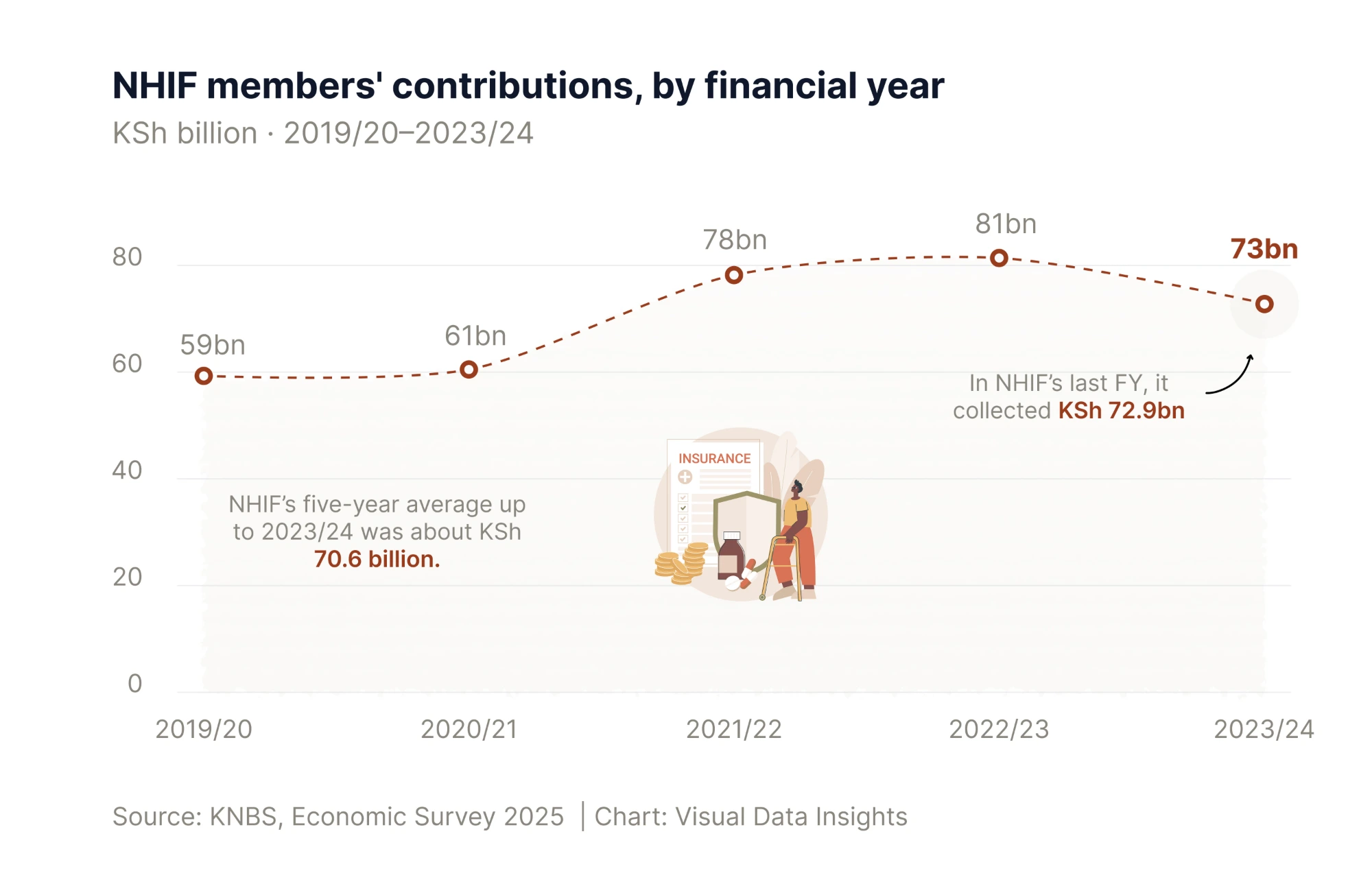
Judge SHA against the fund it replaced, not the promise on paper. NHIF's last five years were not the record of a scheme in crisis. Contributions rose in four of five years, from KSh 59.5 billion in 2019/20 to a peak of KSh 81.6 billion in 2022/23, before easing to KSh 72.9 billion in its final year.
Kenyans complained for decades about queues, denied claims and hospitals that quietly refused NHIF cards. But the fund could pay its bills — its payout ratio never crossed 94 per cent in any of those five years.
The reckoning
SHA is not one fund but three. The Primary Health Care Fund and the Emergency, Chronic and Critical Illness Fund are paid for directly by the exchequer, not by premiums — and in 2024/25 both ran close to fully funded, with payout ratios above 95 per cent. If SHA were only these two, this would be a short article.
It is the third fund — the Social Health Insurance Fund, built on the 2.75 per cent levy — that decides whether universal cover can pay for itself. In its first full year, The contributory SHIF collected KSh 57.7 billion but incurred claims amounting to KSh 91.5 billion, which included KSh 33.4 billion in claims liabilities resulting in a utilization ratio of 158.6%
So, is SHA the answer?
The two tax-funded pieces of SHA are working close to as designed. The member-funded piece — the one meant to prove Kenyans would pay into their own cover — lost money in its first year at a rate that would sink a private insurer inside two years.
Whether that is a rough start or a structural flaw is a question next year's numbers will answer, not this one's. If SHIF's collections climb back toward NHIF's old baseline and the payout ratio falls under 100 per cent, the transition will read as a hard but successful reform. If the gap widens again, Kenya will be asking a different question — not whether SHA can reach every county, but whether a 2.75 per cent levy can ever cover what it promises to pay.
Universal coverage was never going to be free. The open question is who ends up paying for the gap.