climate
One in four cars sold in 2025 was electric ⚡
Electric cars are no longer a niche bet on the future. In 2025, one in four new cars sold worldwide was electric, but the shift is moving at very different speeds — from Norway's near-total EV takeover to America's slower 10% adoption rate.
Timothy Pesi · 2026-09-01
The electric car has stopped being a futuristic prop in a clean-energy PowerPoint. In 2025, it became a regular customer at the world's car dealerships.
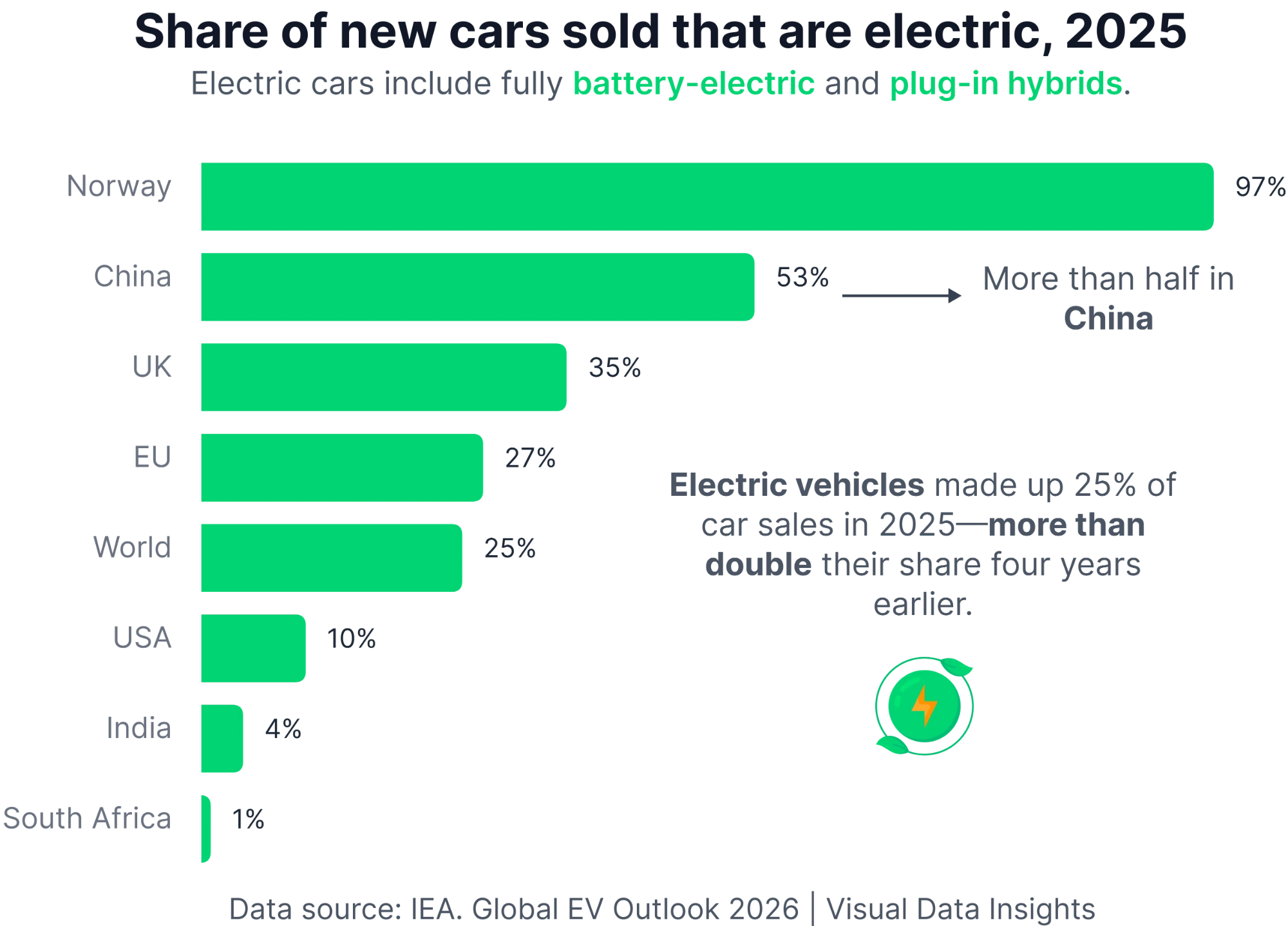
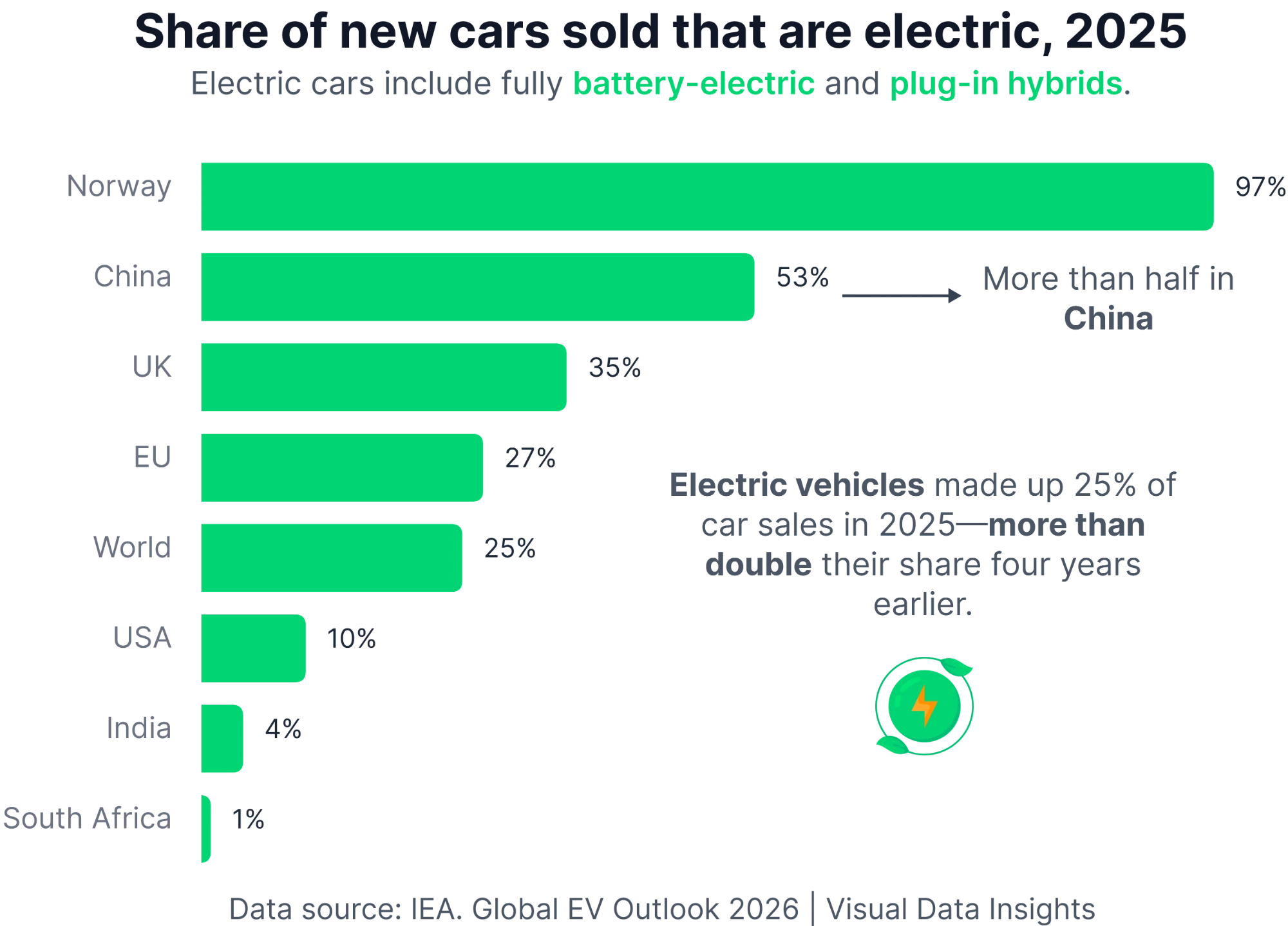
According to the International Energy Agency's latest Global EV Outlook estimates, 25% of new cars sold globally in 2025 were electric. That includes both battery-electric vehicles and plug-in hybrids. Put simply: one in every four new cars came with a plug. That is more than double the share from just four years earlier. The EV transition is no longer a niche experiment conducted by climate-conscious early adopters and Silicon Valley engineers in zip-up fleece. It is now a mass-market shift — though, as with most global revolutions, it is arriving unevenly.
So, let's pop the hood and inspect the geography of this electric surge.
A world divided by charging cables
The global average tells one story. The country-level numbers tell a much sharper one. In Norway, electric vehicles accounted for 97% of new car sales in 2025. That is not adoption; that is near-total conquest. Petrol cars there now look less like mainstream transport and more like historical reenactment equipment. In China, EVs reached 53% of new sales. More than half of new cars sold in the world's largest car market were electric. This matters enormously. When China moves, the global car industry does not merely take notes. It rewrites its business plan, calls three emergency board meetings and starts using phrases like "strategic realignment."
Then comes Europe. The UK stood at 35%, while the EU reached 27%. Both are above the global average, though not quite in Norway's "petrol is basically a museum exhibit" category. The United States, meanwhile, sat at 10%. That is meaningful progress, but still far behind China and Europe. America's EV market remains caught between Tesla enthusiasm, pickup-truck loyalty, charging anxiety and the deep national belief that a vehicle should be able to tow a boat, survive a flood and make a political statement.
At the lower end, India reached 4%, and South Africa just 1%. These figures show that the EV boom is real, but not yet universal.
Norway is the future — just with more fjords
Norway's 97% EV share is extraordinary, but it is not magic. It reflects years of policy support, tax incentives, charging infrastructure and high consumer trust in electric mobility. The country has become the world's EV laboratory. What it shows is simple: when electric cars are affordable, convenient and supported by infrastructure, consumers do not need much convincing. They switch. Norway also proves that the debate over whether people "really want" electric cars can be a little theatrical. Make the economics work, make charging easy, and the market starts behaving less like a stubborn mule and more like a very efficient spreadsheet.
China Has Turned EVs Into Industrial Policy
China's 53% share may be the most consequential number on the chart. This is not just about consumers buying electric cars. It is about manufacturing scale, battery supply chains, government support and intense domestic competition. Chinese EV makers have pushed prices down, expanded model choice and turned electric cars into a mainstream product rather than a luxury statement. For global automakers, this is the uncomfortable part. The EV transition is not only an environmental story. It is an industrial power story. The companies and countries that dominate electric cars may also dominate batteries, software, charging networks and the next generation of auto exports.
In other words, the future of the car industry may be less about who builds the best engine and more about who controls the battery, the chip and the dashboard screen that insists on being smarter than its owner.
America is moving, but slowly
The United States' 10% EV share is not trivial. One in ten new cars being electric still represents a major market. But compared with China, Europe and Norway, it looks cautious. Several things help explain the gap: uneven charging access, long driving distances, political polarization around clean energy and a vehicle market dominated by larger cars and trucks. The American consumer has not rejected the EV. But many are still asking whether it can handle their commute, their road trip, their winter and their imaginary future need to haul lumber. That hesitation matters because the US remains one of the world's most important auto markets. Its speed of adoption will shape investment decisions, charging networks and the strategies of legacy automakers.
The Next EV Race Is Bigger Than Sales
The headline number — 25% globally — is impressive. But the next phase of the EV transition will be harder.
Early adoption was helped by subsidies, wealthy buyers and enthusiastic first movers. The next buyers may be more price-sensitive. They will ask practical questions: Is charging easy? Is the car affordable? Will the battery last? Can I resell it? Will my apartment building install chargers before the next ice age? That means the EV race now shifts from novelty to normality. Governments need infrastructure. Automakers need cheaper models. Power grids need planning. Consumers need confidence.
The road ahead
The chart's message is clear: the electric car has entered the mainstream, but the world is not moving at one speed.
Norway is almost fully electric. China has crossed the halfway mark. Europe is advancing steadily. The US is still in second gear. India and South Africa are barely at the start of the road. Still, the direction is unmistakable. Four years ago, EVs were a fast-growing minority. In 2025, they represented one in four new cars sold worldwide. That is not the end of the combustion engine. But it is the moment when the old auto order began to look less permanent.
The petrol car is not dead. But for the first time, it may be checking the rear-view mirror and seeing something very quiet, very fast and fully charged.