cities
Not Born on the Street
Everyone assumes Kenya's street population was born into it. The country's first census of street families says the opposite — and traces exactly where they came from, and why they left.
Visual Data Insights · 2026-09-01
For years, Kenya's street population has been assumed to be self-perpetuating — children born into destitution, raising children who inherit it. The country's first dedicated census of street families, published by KNBS, tells a different story. Picture a single matatu, the 14-seater kind that rules Kenya's roads, filled entirely with street residents. Roughly nine of those fourteen seats would be taken by someone who once had a family home. Another four would have come from a rented room. Only one seat — barely more than a single passenger — belongs to someone actually born on the street.
If 9 in 10 had a home before the street, the obvious next question is: whose home, and where? The trail leads, overwhelmingly, to two places on the map.
Roots and Routes
Nine in ten street persons, in other words, had a home to lose. And when it comes to where the street-born came from originally, the map behaves like a compass with two dominant poles. Nairobi City and Nakuru — Kenya's largest and fourth-largest counties by population, and its two great magnets for jobseekers — are the birthplaces named most often by street persons who are Kenyan nationals, at 8.6% and 7.6% respectively. The street population, in this sense, has followed the same well-worn migration routes as everyone else chasing work in the city; it has simply run out of road at a different destination.
A home lost, and a road that ran out — but did it sever every tie behind it? The census's most counterintuitive finding says: not quite.
Still Family
Family memory behaves like a rope that frays fastest at one end — the youngest hold the weakest grip, the oldest the strongest.
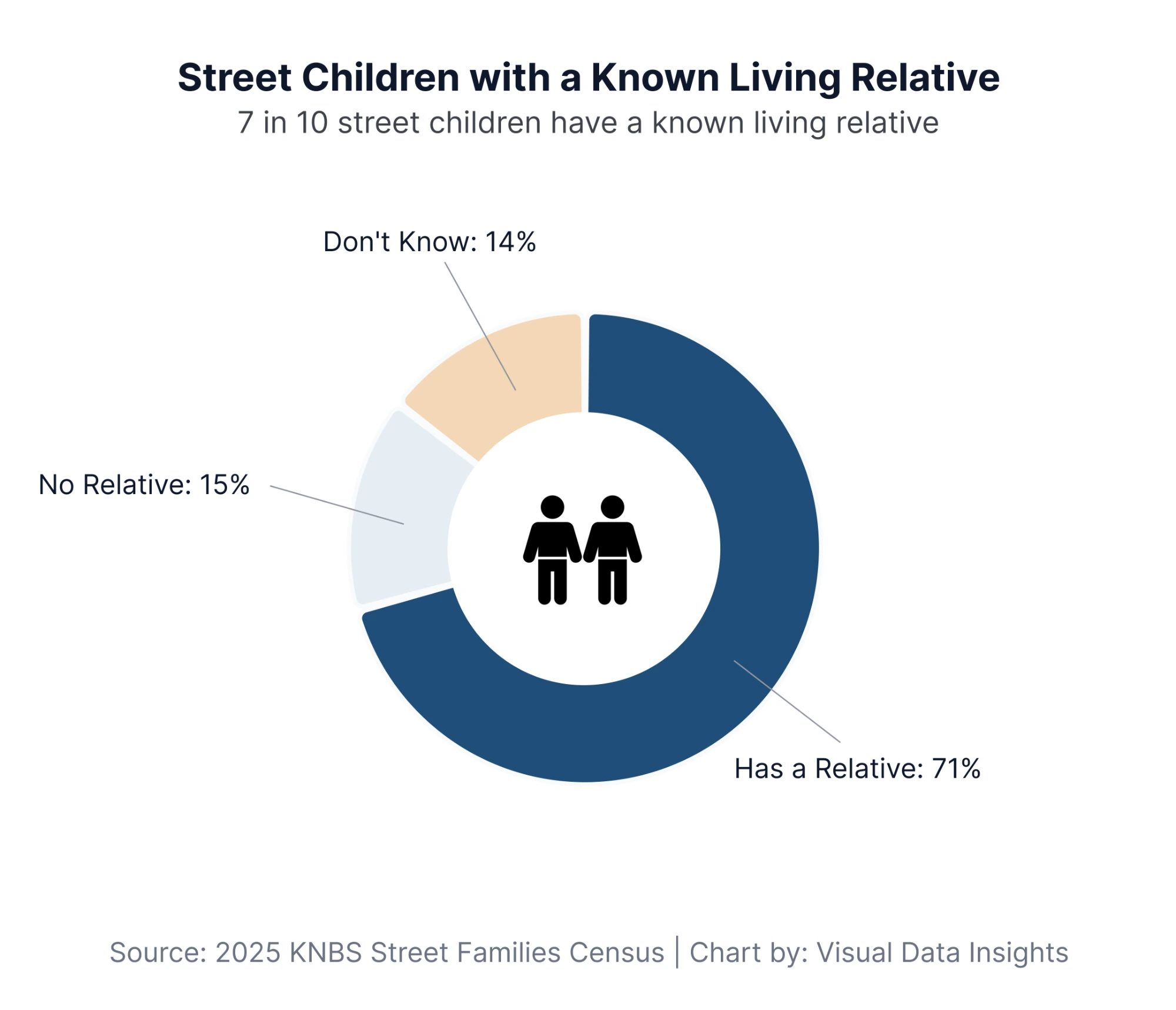
That rupture is rarely total. Among street children nationally, 70.9% have at least one living relative: call a register of any ten street children, and seven would still have a name and a place to send them to. Only 14.5% have no known living relative at all, while a further 14.3% have relatives whose whereabouts nobody currently knows.
A family somewhere still knows their name. So why did they leave in the first place? The answer turns out to be almost embarrassingly simple — and, in one detail, not simple at all.
Follow the Money
What pushes people onto their current base is overwhelmingly economic. Ask ten people on Kenya's streets why they moved, and four or five will give the same one-word answer: work. Nationally, 44.7% relocated in search of employment, well ahead of personal choice (22.4%), other reasons (19.2%) and peer influence (13.7%).
A home lost, a family still reachable, a move driven mostly by the search for work. Put the three findings side by side, and the shape of the right response starts to become obvious.
The Policy Pivot
Taken together, the national numbers read less like a snapshot of an abandoned tribe and more like a scattered address book: most entries still connect to a real family, a county or two away, waiting to be dialled. That reframes the policy problem. This is not principally a population born into homelessness that needs to be found and processed from scratch. It is a population with addresses, family names and, in most cases, someone still alive who remembers them — pushed out chiefly by economic pressure, and in a meaningful share of cases, by violence. That distinction changes what a solution looks like: reunification and family tracing, not just shelter.