climate
More Boreholes, But Is the Water Safe?
Data from the Ministry of Water, Sanitation and Irrigation shows that Kenya increased the number of boreholes drilled from 20,409 in 2020/21 to a projected 47,199 in 2024/25 — a 131% increase
Visual Data Insights · 2026-09-01
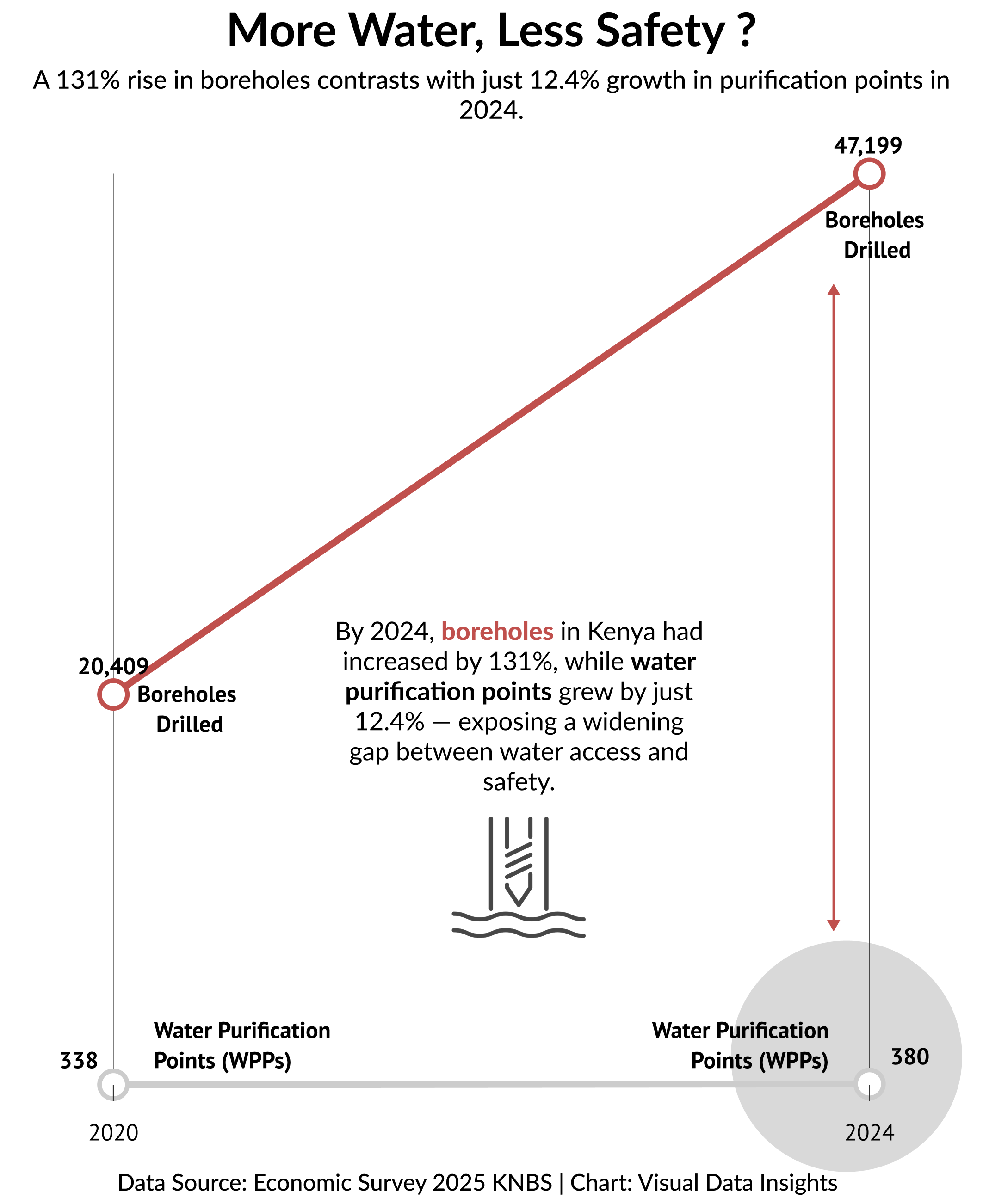
Despite a drilling boom, the country lags behind in ensuring water purification.
Over the last five years, Kenya has witnessed an unprecedented surge in the number of boreholes drilled — a welcome sign in a country where climate variability, population growth, and urban expansion are intensifying demand for reliable water sources.
Yet, beneath the impressive growth lies a troubling truth: while access to water is expanding, the infrastructure to ensure its safety is not keeping pace.
A drilling boom
Data from the Ministry of Water, Sanitation and Irrigation shows that Kenya increased the number of boreholes drilled from 20,409 in 2020/21 to a projected 47,199 in 2024/25 — a 131% increase. This explosion in activity has been driven largely by the private sector, responsible for nearly 90% of all new boreholes in recent years.
This surge reflects both growing demand and the attractiveness of water infrastructure investments in underserved regions. But access is only half the equation. Are they just drilling for profit?
The silent lag
In stark contrast, the number of Water Purification Points (WPPs) — essential for ensuring that groundwater is safe for human consumption — has barely budged. From 338 WPPs in 2020/21 to only 380 in 2024/25, this represents a paltry 12.4% increase over the same five-year period.
That's an increase of just 42 units over five years, compared to over 26,000 new boreholes.
The growing safety gap
Kenya is, in essence, drilling faster than it can purify. The widening gap between water access and water quality poses real risks:
Health risks: Unpurified groundwater may contain pathogens, heavy metals, or chemical contaminants.
Inequality: Rural and low-income communities may access water through boreholes but lack purification infrastructure.
Sustainability: Safe water is central to Kenya's Vision 2030 and its commitment to the UN Sustainable Development Goals.
What needs to change
Kenya's focus on expanding water access is commendable. But clean water is not just about quantity — it's about quality.
If the country does not accelerate the rollout of water purification infrastructure, it risks undermining the very gains it has made. Boreholes may quench thirst, but without proper purification, they may also introduce a new wave of public health challenges.
It's time Kenya drilled with one hand and purified with the other.