economy
Bread, Borrowed
Kenya's wheat fields produced less in 2025 than in any year since 2021. Almost nobody at the bakery noticed — and the numbers explain exactly why.
Visual Data Insights · 2026-09-01
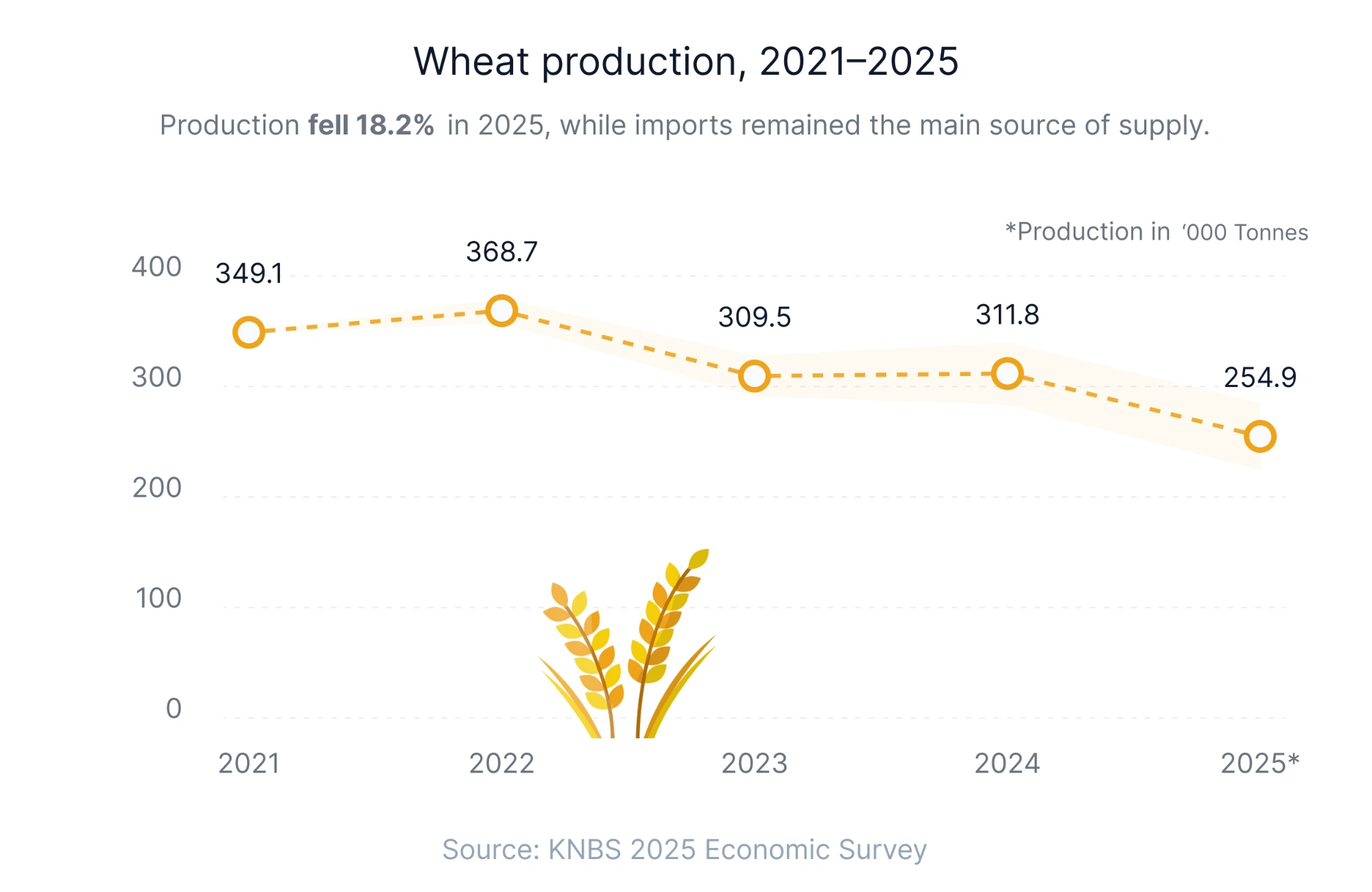
Picture the whole of Kenya's annual wheat harvest tipped into a single convoy of 40-tonne trucks, bumper to bumper, leaving the fields for the mills. In 2022, that convoy ran to more than 9,200 trucks. By 2025, it was down to roughly 6,370 — for every three trucks that rolled out three years ago, only two roll out today. National wheat production fell 18.2% in a single year, to 254.9 thousand tonnes, the lowest figure in the five years KNBS has been tracking it.
A harvest that keeps shrinking doesn't happen by accident. Three quiet culprits are working the same fields — and none of them show up on a rainfall map.
Why the Fields Fell Quiet
The official explanation reads like a checklist of small erosions rather than one dramatic cause. Farmers have been replanting seed saved from their own last harvest instead of buying fresh certified stock — agronomically, the equivalent of photocopying a photocopy: each generation a little fainter, a little less true to the original. Landholdings keep splitting between heirs, so fields that once ran a combine harvester in a single pass are now too narrow and too many to work efficiently. And swarms of quelea birds, Africa's most destructive grain pest, strip ripening heads before they can be threshed. Layer on top of all that a simple market signal: with other crops fetching better prices, some farmers have quietly switched fields out of wheat altogether.
Kenya's wheat problem isn't a single bad season. It's four small leaks in the same tank, all draining at once.
A shrinking harvest has to be made up somewhere. It was — at the port, not the farm.
Bread, Borrowed
Kenya closed the gap the way it always does: at the docks. Imports covered 89.8% of the country's entire wheat supply in 2025 — roughly nine tonnes shipped in for every one grown at home. Total domestic wheat supply came to 2,490.4 thousand tonnes, of which imports alone made up 2,235.5 thousand tonnes. Wheat, in other words, is grown in Kenya more as a formality than a food source; the flour in most chapati, mandazi and loaves of bread has, at some point, crossed an ocean.
If imports are carrying nine-tenths of the load, you'd expect them to have grown to match the shortfall. They didn't — and the reason says something reassuring about how the system absorbed the shock.
The Takeaway
The gap is being plugged almost entirely from abroad, and only stayed invisible to consumers this year because of stock built up the year before. That cushion, by definition, cannot be relied on twice in a row. A country that imports nine-tenths of a staple crop is, in effect, outsourcing its food security to global supply chains, shipping costs and exchange rates—a strategy that works until global prices rise, imports are disrupted, or domestic reserves run thin.