economy
Kenya Trades Less Than in 2005. Its Neighbours Trade More
Across most of the African countries, trade ranges from 2 percent of GDP in Sudan to 206 percent in Djibouti. East Africa's trade hub is one of the few big economies heading down the table.
Visual Data Insights · 2026-11-10
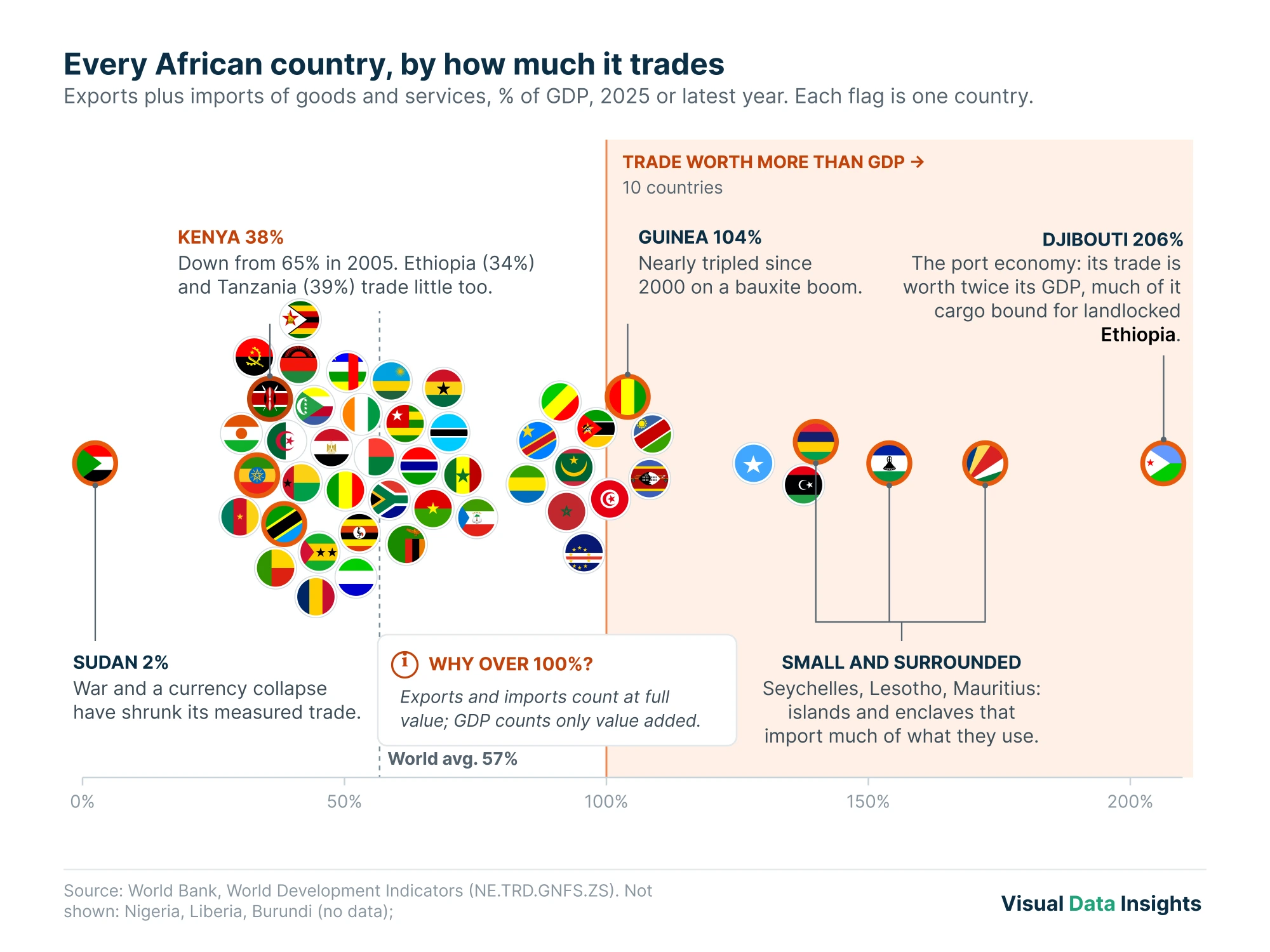
Djibouti buys and sells goods and services worth twice the size of its economy. Sudan trades the equivalent of 2 percent of its own. Between those two extremes sit 47 other African countries, and where each one lands says a lot about how it makes a living.
The measure is simple: exports plus imports, divided by GDP. On the World Bank's latest figures, 10 African countries trade more than their entire output, and 26 of 49 trade more than the world average of 57 percent. Nigeria, the continent's largest economy, is missing. This release has no recent figures for it.
When Trade Outpaces Growth
A ratio above 100 percent looks impossible until you remember what is being counted. Exports and imports enter at their full value. GDP counts only the value added at home. A country that imports fuel, re-exports goods and handles other people's cargo can trade far more than it produces.
That is Djibouti's model. Its port serves landlocked Ethiopia, and its trade has been worth at least twice its GDP in every year since records begin in 2013, when it peaked at 348 percent.
The rest of the right-hand tail follows a pattern. Seychelles (172 percent) and Mauritius (140 percent) are islands. Lesotho (154 percent) and Eswatini (108 percent) are surrounded by South Africa. With small home markets, much of what people consume has to be imported. Libya (138 percent) and Guinea (104 percent) are big exporters of oil and bauxite.
Kenya is moving the other way
Kenya sits near the bottom, at 38 percent. That alone is not unusual: economies with large domestic markets tend to trade less relative to their size. What stands out is the direction.
In 2005, Kenya's trade was worth 65 percent of GDP, its highest level this century. By 2020 it had fallen to 30 percent. It has recovered only partway since.
Its neighbours have gone the other way. Rwanda's ratio rose from 38 percent in 2005 to 57 percent in 2025, and Uganda's from 39 to 50. Tanzania's barely moved, from 37 to 39.
A falling ratio does not mean Kenya sells less abroad in dollar terms. It means trade has grown more slowly than the rest of the economy. For the country that hosts the region's main port, that is still the wrong direction.
In 2005 Kenya's trade was worth 65 percent of its economy. Today it is 38.
When the Ratio Reflects Currency
Two numbers at the bottom of the table need a warning label. Sudan's ratio fell from 26 percent in 2019 to 2 percent in 2024. Ethiopia's doubled in a single year, from 17 percent in 2024 to 34 percent in 2025.
Neither shift is mainly about ships and containers. When a currency is devalued sharply, or when inflation runs far ahead of an official exchange rate, the ratio can swing for reasons that have little to do with how much a country actually trades. Both figures are best read as rough until the numbers settle.
Step back, and the continent as a whole has barely moved. Of the 42 countries with figures for both years, 23 trade more relative to their economies than in 2005 and 19 trade less; the typical country is up by about one percentage point.
If the African Continental Free Trade Area delivers what it promises, this is the chart where it should show up first.