economy
Quickmart’s KES 1,000 Receipt: What Its IPO Really Offers
Quickmart has quadrupled its profit margin, paid out more than it earned and is betting on a growth rebound.
Visual Data Insights · 2026-09-24
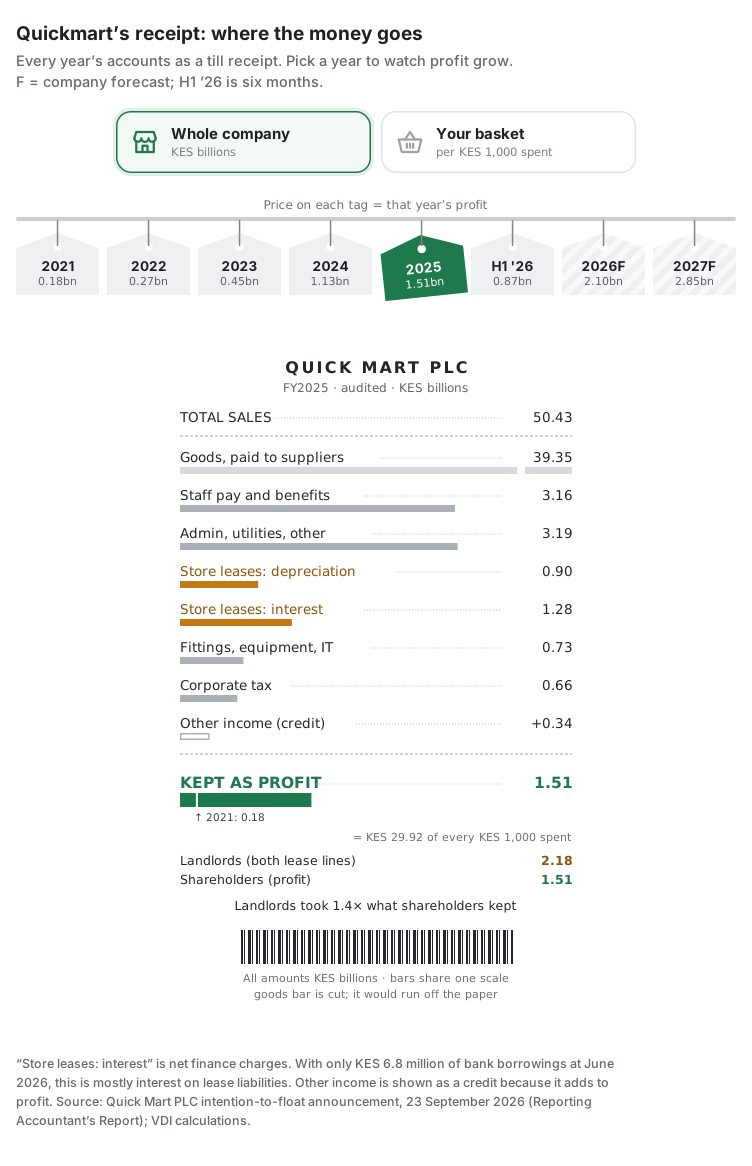
Last year, shoppers handed Quickmart KES 50.4 billion. The company kept KES 1.51 billion of it as profit. Numbers that big are hard to picture. So shrink them to one shopping trip.
Of every KES 1,000 spent, about KES 780 went straight back to suppliers. Staff and running costs took KES 126, landlords KES 43, fittings and equipment KES 14, and the taxman KES 13.
Other income added back about KES 7. What was left was profit: just under KES 30. On Wednesday, Quick Mart PLC, one of Kenya’s largest supermarket chains, announced plans to list on the Nairobi Securities Exchange. Its sole owner will sell half the company: 2 billion existing shares, or up to 57.5% if an over-allotment option is used in full.
The offer is expected to open around 30 September. No price has been published yet.
The receipt below prints Quickmart’s accounts for every year in the filing. Tap “Your basket” to shrink it to a single shopping trip, the measure this story follows.
From KES 7 to KES 30
Set the receipt to your basket and pick 2021, the earliest year in the filing. The same KES 1,000 left Quickmart just KES 7.11.
Since then revenue has roughly doubled, from KES 25.7 billion to KES 50.4 billion. Reported profit rose more than eightfold, from KES 183 million to KES 1.51 billion. One caveat. 2021 profit was weighed down by costs the company treats as one-offs, including merger and COVID-related expenses. On its own unaudited adjusted measure, profit roughly quadrupled, from KES 448 million to KES 1.71 billion. Still a striking run.
So where did the extra shillings come from? Not mainly from a bigger mark-up. Gross margin crept from 21.1% to 22.0% of sales, worth about KES 9 per KES 1,000. The bigger gain was quieter: sales grew faster than costs. Per KES 1,000, lease costs fell from about KES 54 to KES 43, fittings and equipment from KES 22 to KES 14, and staff and overheads from KES 132 to KES 126.
The taxman took back almost KES 10 of the gain. And that lease line, the highest cost after goods and staff, is where the story turns.
The Landlord Line
Quickmart owns none of its 72 stores. In 2025, leases cost KES 2.18 billion—more than the KES 1.51 billion it kept as profit. In 2021, leases cost more than 7 times its profit. Quickmart barely borrows from banks, but it carries years of rent as lease liabilities. By 2027F, the company projects the gap will nearly disappear: KES 42.24 of profit versus KES 42.66 paid to landlords per KES 1,000 spent.
Pays Out More Than It Keeps
Whatever reaches the bottom of the receipt has not stayed there long. From FY2022 to FY2025, Quickmart paid KES 3.74 billion in dividends. Over the same four years it reported KES 3.37 billion of profit. Shareholders received about 111% of what the company earned. The peak was 2023: KES 782 million paid out against KES 450 million of profit, a 174% payout.
Dividends are often paid from the previous year’s earnings. Measured that way, the payouts look even larger. How is that possible? Supermarkets collect cash from shoppers quickly and pay suppliers later. That left Quickmart with negative working capital of KES 4.0 billion at June 2026. In effect, suppliers finance part of the business.
Its net assets, by contrast, were only KES 1.9 billion. The dividends are real cash, but they depend on supplier terms holding and shoppers keeping up.
After listing, the board plans to pay out at least 80% of annual profit, twice a year. It projects KES 2.0 billion for 2026 and KES 2.5 billion for 2027: below profit for the first time since 2022, if profit grows as forecast.
The Forecast Needs a Rebound
That is a big if. Revenue growth has slowed three years running: 35.4% in 2022, then 18.5%, 13.3% and just 8.0% in 2025. The forecast has growth nearly doubling, to 15.4% in 2026 and 15.9% in 2027.
H1 2026 offers an early test. Profit reached KES 32 per KES 1,000, above 2025, but sales need to accelerate.
To hit the KES 2.10bn profit forecast, H2 must deliver KES 1.23bn—41% more than H1. Revenue also needs to rise 13.5% in H2.
The forecast rests heavily on a stronger second half.
Who gets the money
Not a shilling of the offer goes to Quickmart. It is a sale of existing shares, with the proceeds going to the current owners. The company plans to fund 10–15 new stores a year mainly from internal cash flow—the same cash that has supported hefty dividends.
Until the offer price is known, the valuation remains an open question. At KES 10 a share, the 2026 dividend would imply a 5% yield and the stock would trade at roughly 19 times projected earnings.
Quickmart has grown its slice of every KES 1,000 from KES 7 to KES 30 in four years. Its 2027 forecast puts that at KES 42.
The IPO is a bet that Quickmart can finally make the shareholder’s slice as big as the landlord’s.